Thursday, December 16, 2010

Homage to New York, Tinguely


Tinguely's Homage to New York incorporated more than just his mind into the creation of a sculpture for the Museum of Modern Art's sculpture garden. What was created is a direct correlation to the numerous minds working on it, speaking to the tendency to see things differently from one mind to another. While machine-like in its appearance, the above sculpture doesn't actually aim at producing anything. Instead, all ideas were simply thrown together with no mind as to how they would actually work together. With it chaotic nature, this piece is an interesting commentary on the Big Apple city itself. As the machine basically destroyed itself, viewers clamored to get pieces of it to take home. These pieces became new functioning pieces of art within their homes, remembrances of what was once whole. It speaks to New York's ever-evolving status and ever-changing population and interests. 

Living Still Life, Dali

Salvador Dali certainly dwells in the realm of the irrational within the artistic world. In “Living Still Life,”  Dali takes the normal concept of a still-life and turns it on its head. It appears to be almost a magic trick, with all the normal still-life objects (apple, bowl, utensils, a cup) hovering above the table. Dali tricks his viewers’ minds while simultaneously challenging their accepted notion of a still-life. The knife and glass appear to be in motion simply because they are not sitting still atop the table. It is ironic because nothing in this picture is still, yet it is captured as a still life. It also provides a challenge with placing the location--half outside, half in, above water, yet a hand reaching over the railing. It is completely irrational and yet the cleverness comes through. Still, one remains questioning the concept of the still life--if anything is ever really staying still, fully restrained from changing or moving.


Starry Night, Van Gogh


Van Gogh’s paintings are not normally put into the category of “the irrational.” There topics and subject matter are discernible, but his style and depiction of these elements are what stretches over into the creative, atypical realm. Take “Starry Night” for instance. We understand that those glowing, swirling orbs are stars, but his portrayal of them is one that takes us out of our universe. We see them as the pulsing orbs of gas that they are and with a strength rarely witnessed on earth. The wind itself has become visible, and not just through the effects it has on trees and ground-bound objects. The moon, though clearly a crescent moon in the real world scene he is aiming to depict, glows with such intensity that it appears to illuminate the full circle of itself. The landscape itself is not specifically important: the focus becomes the sky and the cypress tree which is obstructing the full viewing of it. The irrational does not necessarily imply ridiculous or otherworldly in every case, just a new way of seeing.

The Kiss, Klimt


The work of Gustav Klimt, the Austrian painter most known for “The Kiss,” focuses on the depiction of the irrational, but in a way that relies on the rational. Klimt is most famous for his ‘Golden Phase,’ the period of time in which he created works heavily reliant on gold-leafing. This period is the one in which “The Kiss” was created as well as many others that utilize the same blanketing gold and smattering of designs to cover up the bodies and positioning of his subjects. While these paintings rely on actual human subjects and familiar objects as their subject matter, what in turn dominates the painting is the presence of his asymmetrical, random designs. There is a freedom given to his viewing audience as well in covering up the areas of the body that would tell a story through their action. He has clearly rejected the naturalistic style and aimed to use the body as a canvas for conveying a sense of freedom that visually breaks with tradition.

Sunday, December 12, 2010

Garden of Earthly Delights, Bosch


This picture is so obnoxiously detailed that I have to make it un-aesthetically pleasing and enlarge it EXCESSIVELY. What were you thinking, Bosch-man? 


On the left you have Adam and Eve in Eden in the presence of God. 

On the right you have hell in all its horror and torture. 

And in the middle you have one big orgy. 

Whether Bosch was trying to portray this as a scene of immense, unimaginable pleasure or a warning against excess we don't know.  Either way, the artist puts his viewers in the position of peeping toms, making people from his era and ours probably feel a little uncomfortable and a little curious as to what was happening. 

I feel as though this is an "irrational" image because I don't believe that the middle ground between paradise and hell is excessive copulation. Personal opinion though. Others are free to disagree. 

CARMEN (A True Madrilena--the best student you have in your Modern Art Class) THINKS
"It portrays the twisted views that the Medieval people had of paradise and hell....(she'll continue in Spanish)...este triptico muestra la vision dualista el mundo, que los artistas medievales tenian del cielo y el infierno,siendo este ultimo, un lugar actualmente fisico, en el que los hobres seran castigados por sus pecados de gula, pasion y fornicacion.

BIEN!


Presentation to a Mayan Ruler, Bonampak mural


The palace of Bonampak help to illuminate aspects of the Mayan culture that still remain mysterious and dark. In one room, the murals depict the presentation of the next heir to the Mayan throne. It is a very lavish celebration with a huge procession of nobles proceeding the newest leader of the dynasty, giving a sense of solidarity in the impending leader change. The other room tells the story of a major battle in which the Mayans were triumphant. It shows them processing their enemy captives in front of the ruling heads as those prisoners lament their captivity. 

I don't understand why, being that the Mayans are a real culture, that this is categorized as an irrational image. 


Dionysian Mystery frieze


This detailed frieze in the Villa of the Mysteries stretches along all the walls of the room. It is known to be in honor and praise of the god, Dionysus. He is included in the mural, and although he is on the section on which the most damage is found, we are still able to determine that it is him because of his head wreath of vine leaves and his thyrsus, the pinecone-topped staff he always carries. It is believed to possibly be a room in which the Dionysian initiation ceremonies took place. On the left there is a naked boy reading a scroll, possibly one containing the rites of such a ceremony, while a servant woman holds a tray of possible offerings. 

Chimera of Arezzo


The chimera is an ancient mythological animal that was part lion, part goat, and part serpent. This Etruscan version (one of the most famous pieces of Etruscan art that we have) also seems to incorporate almost dragon-like spikes along its spine. It's a common creature in Greek mythology and so its adoption into the Etruscans only further illustrates the cross-cultural relationship that they had. 

This creature was first referred to by Homer in the Illiad. The description is a brief one, just saying its front was a lion, the back a serpent, and the middle a goat. I find it fascinating that after such a brief mention, the creature was 1) so latched onto and popularized in other literary works and 2) that its depiction was what it was with such a limited physical description. 

Lacoon Grouping

This ancient work's artist is unknown. The only hint we have as to who the creators of this piece are is a reference by Pliny the Elder naming three artists who are said to have worked on this together.

We do however know what's happening in this sculpture, as disconcerting as it is. There is a forever lost play by Sophocles that we have references to in secondary sources that spoke of the story of Lacoon and his sons. Lacoon was a Trojan who did not believe the ruse of the wooden horse left for them by the Greeks. He went to stab it with a spear and Athena, in defense of the Greeks, sent serpents to attack him. Thinking this was a sign to accept it (as it was, though for an evil outcome), the Trojans welcomed it in, to their demise.

Great Sphinx 


The Great Sphinx is probably one of the most recognized symbols left behind by an ancient culture. Located in Giza, this sculpture was carved out of a plateau of bedrock. The creature is surely an irrational one--a combination of a lions body and human head. It is believed to have symbolized the Pharaoh's role as the god Atum here on earth. Currently it is undergoing restoration so that this huge monolith will not be lost forever. 

The reason the Sphinx doesn't have a nose any more is because Napoleon's forces shot it off with a canon by accident. Damn French. 

Saturday, December 11, 2010

Mercenaries, Golub


These powerful images by Leon Golub are from his collection entitled Mercenaries. Social issues have always been points of interest in his art, having run the gamut from race/hate crimes to the Vietnam War. In the 1980s when Golub created this collection along with others, his focus was acts of terrorism and injustice. It wasn't just a statement on war anymore, but how racial inequalities, sexual ambiguity and inequality, and extreme violence are continuing to permeate society on all different levels. These paintings on linen show the larger, international/military perspective, but he also created pieces that focused on the atrocities of gang wars happening on our own streets and the prejudices harbored within one's own home. While many of his pieces are extremely difficult to look at, his rawness delivers the message that isn't always broadcast through our news outlets to incite his audience into action and rebellion against the growing prevalence of these negative issues. 

Nigredo, Kiefer


Anselm Kiefer was born the year World War II ended in Germany. Still, much of his art reflects themes and reminders of the dark times preceding his birth. This piece is photographic at its base, with different materials and artistic procedures added on to the top of it. It's massive canvas is devoted wholly to a German landscape. That landscape though is not a beautiful one. It is torn apart and devastated, recalling the years of war that left Germany in ruin both agriculturally, socially, politically and economically. Kiefer captures that destruction in this piece. However, he gives hope by writing the word, Nigredo, in the top left corner of the painting. Nigredo refers the alchemy, the process of the Medieval times that was believed to turn regular matter into gold. Nigredo is the first step of this long-ago process in which a burning takes place that is then followed by the presence of light. Through his painting, Kiefer is able to fortify his belief that though his country has been brought to its knees by years of conflict and war, it still has the power to rise up and become something beautiful and luminous. 

Monument for the 3rd International, Tatlin 

Vladimir Tatlin saw his piece of architecture as a way to celebrate the success of the Bolshevik Revolution. It was to be erected in St. Petersburg (Petrograd at the time), but it never was. Hearing his plans for this structure in this day and age, it makes sense. The building was quite beyond its time in construction and technology.

The three levels were going to have one room of different sizes and shapes on each. The bottom level of a cube would be used for conferences and meetings, the middle pyramid for executive activities, and the top cylinder for press activities. Each level would rotate at a different speed respectively: a year,  a month, and a day.  It would be the headquarters for the Comintern.

Never having been built, it stands as a fitting testament of the Soviet mission and its failure to follow-through.

“When I Put My Hands...," Wojnarowicz


Incorporating text works into a photograph that the he took himself, Wojnarowicz uses the piece to deliver the message clearly. His words illuminate what the picture was most likely intended to convey, enhancing them and leaving no doubt. Specifically, the words speak of an event in which the speaker puts his hands on the body of another and sees the body unravel beneath him, revealing all the common layers of the anatomy that we all share. In my opinion, the words are exceptionally poetic, but the idea they are conveying is extremely creative. The photo behind shows how his words are true--that we are all the same underneath and will one day look the same despite our present exterior differences.

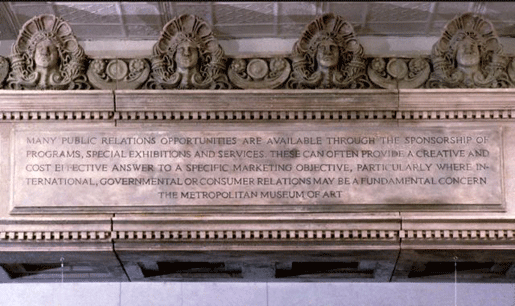
MetroMobiltan, Haacke 


Haacke blends political, environmental, industrial, and humanitarian concerns all into this one piece of art. Aimed to look like the front banners of the Metropolitan Museum, Haacke uses this display to speak about the involvement that the Mobil Corporation has had in Africa. Behind the banners are the reality of the disservice the company is doing--a collage of pictures from Black South Africans' funerals. The elevation of the piece off the fiberglass layer beneath it gives the impression of a great weight being lifted or maintained aloft. 


The cornice piece above does not display the normal carved words either. It speaks to the beneficial effects of sponsorship relationships between corporations and groups of people. That is on the facade along with the banners that seem to support the same "positive" impact of the corporation. Both of these pieces and their intended messages are devalued when beneath them stands the truth--the negative impacts of such relationships. 

Friday, December 10, 2010

Cornered, Piper

This piece of art deals with issues of race. The woman on the TV talks about how she is black when on the surface she does not appear to be. However, the birth certificates to the left and the right of the television screen show the differences of perspective on the issue, tracing the same name back to two different racial backgrounds. The art display invites viewers to sit down and partake in the dialogue of the woman on the screen. The table overturned beneath her seems to symbolize the need to overturn standard perception and conception of ideas. The piece challenges society to think outside preexisting racial stereotypes and expectations.

Homeless Projection, Wodiczko 


Wodiczko uses the facades of buildings and monuments as his canvas. He projects slides or videos on their surfaces with the purpose of drawing the public's attention towards issues that are socially unsavory, in this specific picture: homelessness. Wodiczko even went around during the day, asking homeless men and women to display their belongings around the base of his monument now transformed into a bundled up homeless person. This alone helped to enhance the reality of his message. 

Migrant Mother, Lange

Lange worked for the Farm Security Administration during the Great Depression, working to bring the real, raw images of the hard times gripping the country to the masses. This photo gained popularity as it displayed the truth of the situation. The woman's name is Florence Owens Thompson. While Thompson's son disagrees with some of the details in Lange's remembrance of the moment she met and shot Thompson's image, it is still an interesting recounting worth including in this entry:

I saw and approached the hungry and desperate mother, as if drawn by a magnet. I do not remember how I explained my presence or my camera to her, but I do remember she asked me no questions. I made five exposures, working closer and closer from the same direction. I did not ask her name or her history. She told me her age, that she was thirty-two. She said that they had been living on frozen vegetables from the surrounding fields, and birds that the children killed. She had just sold the tires from her car to buy food. There she sat in that lean-to tent with her children huddled around her, and seemed to know that my pictures might help her, and so she helped me. There was a sort of equality about it.


After Pearl Harbor was bombed, Lange worked to photograph the injustices against the Japanese as internment started to take place. Her popularity with the government declined during those years when she strove to criticize their decisions through her photography. 


Vietnam Veterans Memorial, Maya Ying Lin


All of these art pieces, with the exception of The Raft of Medusa, deal with the topic of war. This final piece in monument form, The Vietnam Veterans Memorial, works to avoid commentary on the war exclusively and instead focus on those who served in it. In a way, it is the culmination of the points delivered through these many works of art.  When Maya Ying Lin designed the plan for this memorial, she was aware of the controversiality of the war it was remembering, but chose to concentrate instead on “the reality of war and...the people who gave their lives” (Kleiner, 1008).  Her use of the earth and its materials to create this monument lead one to see the possible proverbial arrows Lin laid to point to a “no-war” perspective.  The black granite that laces the edge of a deep cut into the earth summons up dark images. Lin says “I had an impulse to cut open the earth...an initial violence that in time would heal. The grass would grow back, but the cut would remain,” showing that the war itself was a deep scar that could never be completely healed (Kleiner, 1008). The monument’s walkway delivers the feeling of descent to its viewers, as they walk deeper into the slash in the earth and wall continues to grow taller and taller. It is overwhelming, the names of the dead and missing, but in this same monument, elements of positivity can be found. First, it is a place of remembrance, and the remembrance of heroes. It is cathartic and healing, a place of solace and honor. It evokes compassion and thought in its visitors and literally reflects the life that still walks the earth in the polished walls of stone. Lin successfully created “an interface between the world of the light and the quieter world beyond the names” (Kleiner, 1007).  This monument is not founded on the goal to “dictate response” but instead “encourages personal exploration” (Kleiner, 1007). 

A photograph showing how the memorial is like a gash in the ground